January 1, 2019
The case for scientific humanism
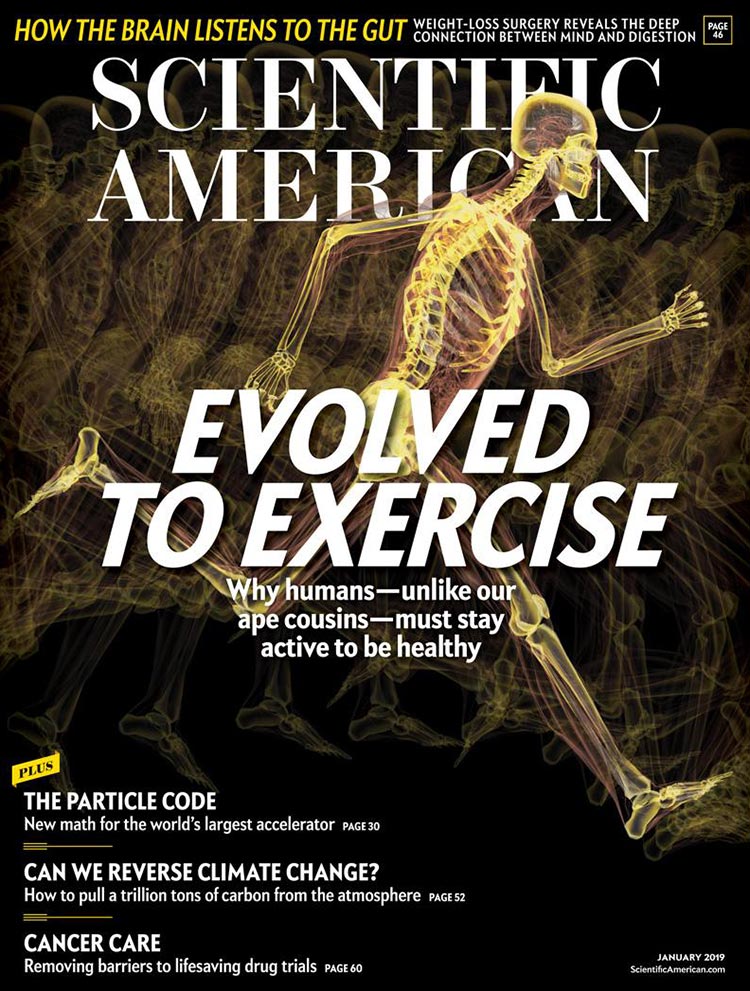
This column was first published in the January 2019 issue of Scientific American.
In the April 2001 issue of Scientific American, I began this column with an entry entitled “Colorful Pebbles and Darwin’s Dictum,” inspired by the British naturalist’s remark that “all observation must be for or against some view, if it is to be of any service.” Charles Darwin penned this comment in a letter addressing those critics who accused him of being too theoretical in his 1859 book On the Origin of Species. They insisted that he should just let the facts speak for themselves. Darwin knew that science is an exquisite blend of data and theory. To these I add a third leg to the science stool—communication. If we cannot clearly convey our ideas to others, data and theory lie dormant.
For 214 consecutive months now, I have tried to communicate my own and others’ thoughts about the data and theory of science as clearly as I am able. But in accordance with (Herb) Stein’s Law—that things that can’t go on forever won’t—this column is ending as the magazine redesigns, a necessary strategy in the evolution of this national treasure, going on 174 years of continuous publication. I am honored to have shared a fleeting moment of that long history, grateful to the editors, artists and production talent for every month I was allowed to share my views with you. I will continue doing so elsewhere until my own tenure on this provisional proscenium ends (another instantiation of Stein’s Law)—many years in the future, nature and chance willing— so permit me to reflect on what I think science brings to the human project of which we are all a part.
Modern science arose in the 16th and 17th centuries following the Scientific Revolution and the adoption of scientific naturalism— the belief that the world is governed by natural laws and forces that are knowable, that all phenomena are part of nature and can be explained by natural causes, and that human cognitive, social and moral phenomena are no less a part of that comprehensible world. In the 18th century the application of scientific naturalism to the understanding and solving of human and social problems led to the widespread embrace of Enlightenment humanism, a cosmopolitan worldview that esteems science and reason, eschews magic and the supernatural, rejects dogma and authority, and seeks to understand how the world works. Much follows. Most of it good.
Human progress, which has been breathtaking over the past two centuries in nearly every realm of life, has principally been the result of the application of scientific naturalism to solving problems, from engineering bridges and eradicating diseases to extending life spans and establishing rights. This blending of scientific naturalism and Enlightenment humanism should have a name. Call it “scientific humanism.”
It wasn’t obvious that the earth goes around the sun, that blood circulates throughout the body, that vaccines inoculate against disease. But because these things are true and because Nicolaus Copernicus, William Harvey and Edward Jenner made careful measurements and observations, they could hardly have found something else. So it was inevitable that social scientists would discover that people universally seek freedom. It was also inevitable that political scientists would discover that democracies produce better lives for citizens than autocracies, economists that market economies generate greater wealth than command economies, sociologists that capital punishment does not reduce rates of homicide. And it was inevitable that all of us would discover that life is better than death, health better than illness, satiation better than hunger, happiness better than depression, wealth better than poverty, freedom better than slavery and sovereignty better than suppression.
Where do these values exist to be discovered by science? In nature—human nature. That is, we can build a moral system of scientific humanism through the study of what it is that most conscious creatures want. How far can this worldview take us? Does Stein’s Law apply to science and progress? Will the upward bending arcs of knowledge and wellbeing reach a fixed upper ceiling?
Remember Davies’s Corollary to Stein’s Law—that things that can’t go on forever can go on much longer than you think. Science and progress are asymptotic curves reaching ever upward but never touching omniscience or omnibenevolence. The goal of scientific humanism is not utopia but protopia—incremental improvements in understanding and beneficence as we move ever further into the open-ended frontiers of knowledge and wisdom. Per aspera ad astra.
December 1, 2018
A looming crisis and how to avert it
This column was first published in the December 2018 issue of Scientific American.
Something is amiss among today’s youth. This observation isn’t the perennial “kids these days” plaint by your middle-aged correspondent. According to San Diego State University psychologist Jean Twenge, as reported in her book iGen (Atria, 2017), to the question “Do you have [a] psychological disorder (depression, etc.)?” the percentage of college students born in 1995 and after (the Internet Generation, or iGen) answering affirmatively in a Higher Education Research Institute study rose between 2012 and 2016. For men, the figure increased from 2.7 to 6.1 percent (a 126 percent increase) and for women from 5.8 to 14.5 percent (a 150 percent rise). The National Survey on Drug Use and Health found that between 2011 and 2016 the percentage of boys who experienced a depressive episode the prior year increased from 4.5 to 6.4 and in girls from 13 to 19.
iGeners began entering college in 2013. Between 2011 and 2016 there was a 30 percent increase in college students who said they intentionally injured themselves (for example, by cutting), and according to the Fatal Injury Reports of the Centers for Disease Control and Prevention, suicide rates increased 46 percent between 2007 and 2015 among 15- to 19-year-olds. Why are iGeners different from Millennials, Gen Xers and Baby Boomers?
Twenge attributes the malaise primarily to the widespread use of social media and electronic devices, noting a positive correlation between the use of digital media and mental health problems. Revealingly, she also reports a negative correlation between lower rates of depression and higher rates of time spent on sports and exercise, in-person social interactions, doing homework, attending religious services, and consuming print media, such as books and magazines. Two hours a day on electronic devices seems to be the cutoff, after which mental health declines, particularly for girls who spend more time on social media, where FOMO (“fear of missing out”) and FOBLO (“fear of being left out”) take their toll. “Girls use social media more often, giving them more opportunities to feel left out and lonely when they see their friends or classmates getting together without them,” Twenge adduces after noting that the percentage of girls who reported feeling left out increased from 27 to 40 between 2010 and 2015, compared with a percentage increase from 21 to 27 for boys. (continue reading…)
November 1, 2018
Why the singular of “data” is not “anecdote”
This column was first published in the November 2018 issue of Scientific American.
For a documentary on horror movies that seem cursed, I was recently asked to explain the allegedly spooky coincidences associated with some famous films. Months after the release of Poltergeist, for example, its 22-year-old star, Dominique Dunne, was murdered by her abusive ex-boyfriend; Julian Beck, who played the preacher “beast,” succumbed to stomach cancer before Poltergeist II’ s release; and 12-year-old Heather O’Rourke died months before the release of what would be her last starring role in Poltergeist III.
The Exorcist star Linda Blair hurt her back when she was thrown around on her bed when a piece of rigging broke; Ellen Burstyn was injured on set when flung to the ground; and actors Jack MacGowran and Vasiliki Maliaros both died while the film was in postproduction (their characters died in the film).
When Gregory Peck was on his way to London to make The Omen, his plane was struck by lightning, as was producer Mace Neufeld’s plane a few weeks later; Peck avoided aerial disaster again when he canceled another flight at the last moment (that plane crashed, killing everyone onboard); and two weeks after filming, an animal handler who worked on the set was eaten alive by a lion. (continue reading…)
October 1, 2018
Why do people die by suicide?
This column was first published in the October 2018 issue of Scientific American.
Anthony Bourdain (age 61). Kate Spade (55). Robin Williams (63). Aaron Swartz (26). Junior Seau (43). Alexander McQueen (40). Hunter S. Thompson (67). Kurt Cobain (27). Sylvia Plath (30). Ernest Hemingway (61). Alan Turing (41). Virginia Woolf (59). Vincent van Gogh (37). By the time you finish reading this list of notable people who died by suicide, somewhere in the world another person will have done the same, about one every 40 seconds (around 800,000 a year), making suicide the 10th leading cause of death in the U.S. Why?
According to the prominent psychologist Jesse Bering of the University of Otago in New Zealand, in his authoritative book Suicidal: Why We Kill Ourselves (University of Chicago Press, 2018), “The specific issues leading any given person to become suicidal are as different, of course, as their DNA—involving chains of events that one expert calls ‘dizzying in their variety.’” Indeed, my short list above includes people with a diversity of ages, professions, personality and gender. Depression is commonly fingered in many suicide cases, yet most people suffering from depression do not kill themselves (only about 5 percent Bering says), and not all suicide victims were depressed. “Around 43 percent of the variability in suicidal behavior among the general population can be explained by genetics,” Bering reports, “while the remaining 57 percent is attributable to environmental factors.” Having a genetic predisposition for suicidality, coupled with a particular sequence of environmental assaults on one’s will to live, leads some people to try “to make the sh*t stop,” in the words of Winona Ryder’s character in the 1999 film Girl, Interrupted. (continue reading…)
September 1, 2018
Education and birth control are slowly making the politics less relevant
In May of this year the pro-life/pro-choice controversy leapt back into headlines when Ireland overwhelmingly approved a referendum to end its constitutional ban on abortion. Around the same time, the Trump administration proposed that Title X federal funding be withheld from abortion clinics as a tactic to reduce the practice, a strategy similar to that of Texas and other states to shut down clinics by burying them in an avalanche of regulations, which the U.S. Supreme Court struck down in 2016 as an undue burden on women for a constitutionally guaranteed right. If the goal is to attenuate abortions, a better strategy is to reduce unwanted pregnancies. Two methods have been proposed: abstinence and birth control.
Abstinence would obviate abortions just as starvation would forestall obesity. There is a reason no one has proposed chastity as a solution to overpopulation. Sexual asceticism doesn’t work, because physical desire is nearly as fundamental as food to our survival and flourishing. A 2008 study published in the Journal of Adolescent Health entitled “Abstinence-Only and Comprehensive Sex Education and the Initiation of Sexual Activity and Teen Pregnancy” found that among American adolescents ages 15 to 19, “abstinence-only education did not reduce the likelihood of engaging in vaginal intercourse” and that “adolescents who received comprehensive sex education had a lower risk of pregnancy than adolescents who received abstinence-only or no sex education.” A 2011 PLOS ONE paper analyzing “Abstinence-Only Education and Teen Pregnancy Rates” in 48 U.S. states concluded that “increasing emphasis on abstinence education is positively correlated with teenage pregnancy and birth rates,” controlling for socioeconomic status, educational attainment and ethnicity. (continue reading…)