May 1, 2017
Why torture doesn’t work
As recounted by author and journalist Daniel P. Mannix, during the European witch craze the Duke of Brunswick in Germany invited two Jesuit scholars to oversee the Inquisition’s use of torture to extract information from accused witches. “The Inquisitors are doing their duty. They are arresting only people who have been implicated by the confession of other witches,” the Jesuits re ported. The duke was skeptical. Suspecting that people will say anything to stop the pain, he invited the Jesuits to join him at the local dungeon to witness a woman being stretched on a rack. “Now, woman, you are a confessed witch,” he began. “I suspect these two men of being warlocks. What do you say? Another turn of the rack, executioners.” The Jesuits couldn’t believe what they heard next. “No, no!” the woman groaned. “You are quite right. I have often seen them at the Sabbat. They can turn themselves into goats, wolves and other animals…. Several witches have had children by them. One woman even had eight children whom these men fathered. The children had heads like toads and legs like spiders.” Turning to the flabbergasted Jesuits, the duke inquired, “Shall I put you to the torture until you confess?”
One of these Jesuits was Friedrich Spee, who responded to this poignant experiment on the psychology of torture by publishing a book in 1631 entitled Cautio Criminalis, which played a role in bringing about the end of the witch mania and demonstrating why torture as a tool to obtain useful information doesn’t work. This is why, in addition to its inhumane elements, torture is banned in all Western nations, including the U.S., whose Eighth Amendment of the Constitution prohibits “cruel and unusual punishments.” (continue reading…)
April 1, 2017
How to think about claims, even the Resurrection
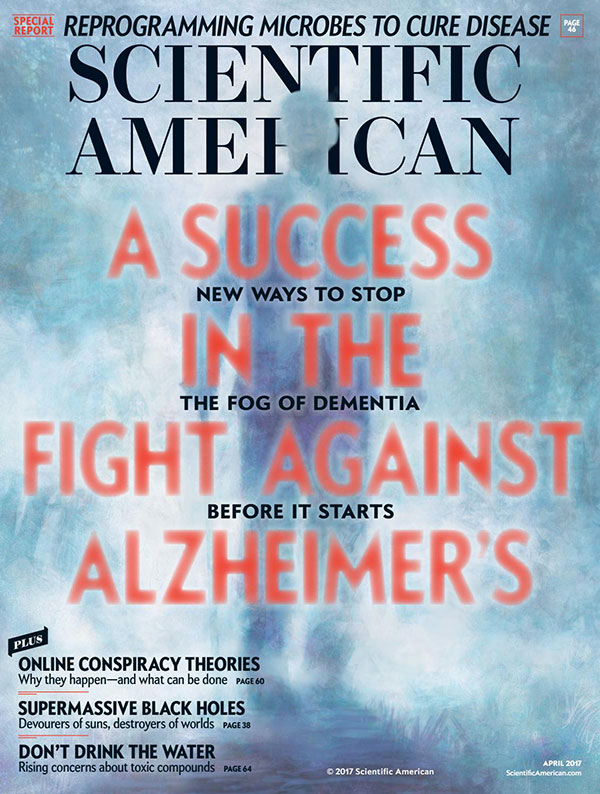
According to the Oxford English Dictionary’ s first definition, a “skeptic” is “one who holds that there are no adequate grounds for certainty as to the truth of any proposition whatever.” This is too nihilistic. There are many propositions for which we have adequate grounds for certainty as to their truth:
There are 84 pages in this issue of Scientific American. True by observation.
Dinosaurs went extinct around 65 million years ago. True by verification and replication of radiometric dating techniques for volcanic eruptions above and below dinosaur fossils.
The universe began with a big bang. True by a convergence of evidence from a wide range of phenomena, such as the cosmic microwave background, the abundance of light elements (such as hydrogen and helium), the distribution of galaxies, the large-scale structure of the cosmos, the redshift of most galaxies and the expansion of space.
These propositions are “true” in the sense that the evidence is so substantial that it would be unreasonable to withhold one’s provisional assent. It is not impossible that the dinosaurs died a few thousand years ago (with the universe itself having been created 10,000 years ago), as Young Earth creationists believe, but it is so unlikely we need not waste our time considering it. (continue reading…)
March 1, 2017
Artificial intelligence as existential threat
In 2014 SpaceX CEO Elon Musk tweeted: “Worth reading Superintelligence by Bostrom. We need to be super careful with AI. Potentially more dangerous than nukes.” That same year University of Cambridge cosmologist Stephen Hawking told the BBC: “The development of full artificial intelligence could spell the end of the human race.” Microsoft co-founder Bill Gates also cautioned: “I am in the camp that is concerned about super intelligence.”
How the AI apocalypse might unfold was outlined by computer scientist Eliezer Yudkowsky in a paper in the 2008 book Global Catastrophic Risks: “How likely is it that AI will cross the entire vast gap from amoeba to village idiot, and then stop at the level of human genius?” His answer: “It would be physically possible to build a brain that computed a million times as fast as a human brain…. If a human mind were thus accelerated, a subjective year of thinking would be accomplished for every 31 physical seconds in the outside world, and a millennium would fly by in eight-and-a-half hours.” Yudkowsky thinks that if we don’t get on top of this now it will be too late: “The AI runs on a different timescale than you do; by the time your neurons finish thinking the words ‘I should do something’ you have already lost.”
The paradigmatic example is University of Oxford philosopher Nick Bostrom’s thought experiment of the so-called paperclip maximizer presented in his Superintelligence book: An AI is designed to make paperclips, and after running through its initial supply of raw materials, it utilizes any available atoms that happen to be within its reach, including humans. As he described in a 2003 paper, from there it “starts transforming first all of earth and then increasing portions of space into paperclip manufacturing facilities.” Before long, the entire universe is made up of paperclips and paperclip makers. (continue reading…)
February 1, 2017
Science contemplates the incomprehensible
Imagine nothing. Go ahead. What do you see? I picture dark empty space devoid of galaxies, stars and planets. But not only would there be no matter, there would be no space or time either. Not even darkness. And no sentient life to observe the nothingness. Just … nothing. Picture that. You can’t.
Here we face the ultimate question: Why is there something rather than nothing? I have compiled several responses from a number of sources, including a 2013 book by John Leslie and Robert Lawrence Kuhn entitled The Mystery of Existence (Wiley-Blackwell) and Lawrence M. Krauss’s 2017 book The Greatest Story Ever Told—So Far (Atria Books).
Nothing is nonsensical. It is impossible to conceptualize nothing— not only no space, time, matter, energy, light, darkness or conscious beings to perceive the nothingness but not even nothingness. In this sense, the question is literally inconceivable. (continue reading…)
January 1, 2017
Why worldview threats undermine evidence
Have you ever noticed that when you present people with facts that are contrary to their deepest held beliefs they always change their minds? Me neither. In fact, people seem to double down on their beliefs in the teeth of overwhelming evidence against them. The reason is related to the worldview perceived to be under threat by the conflicting data.
Creationists, for example, dispute the evidence for evolution in fossils and DNA because they are concerned about secular forces encroaching on religious faith. Anti-vaxxers distrust big pharma and think that money corrupts medicine, which leads them to believe that vaccines cause autism despite the inconvenient truth that the one and only study claiming such a link was retracted and its lead author accused of fraud. The 9/11 truthers focus on minutiae like the melting point of steel in the World Trade Center buildings that caused their collapse because they think the government lies and conducts “false flag” operations to create a New World Order. Climate deniers study tree rings, ice cores and the PPM of greenhouse gases because they are passionate about freedom, especially that of markets and industries to operate unencumbered by restrictive government regulations. Obama birthers desperately dissected the president’s long-form birth certificate in search of fraud because they believe that the nation’s first African- American president is a socialist bent on destroying the country.
In these examples, proponents’ deepest held worldviews were perceived to be threatened by skeptics, making facts the enemy to be slayed. This power of belief over evidence is the result of two factors: cognitive dissonance and the backfire effect. In the classic 1956 book When Prophecy Fails, psychologist Leon Festinger and his co-authors described what happened to a UFO cult when the mother ship failed to arrive at the appointed time. Instead of admitting error, “members of the group sought frantically to convince the world of their beliefs,” and they made “a series of desperate attempts to erase their rankling dissonance by making prediction after prediction in the hope that one would come true.” Festinger called this cognitive dissonance, or the uncomfortable tension that comes from holding two conflicting thoughts simultaneously. Two social psychologists, Carol Tavris and Elliot Aronson (a former student of Festinger), in their 2007 book Mistakes Were Made (But Not by Me) document thousands of experiments demonstrating how people spin-doctor facts to fit preconceived beliefs to reduce dissonance. Their metaphor of the “pyramid of choice” places two individuals side by side at the apex of the pyramid and shows how quickly they diverge and end up at the bottom opposite corners of the base as they each stake out a position to defend. (continue reading…)