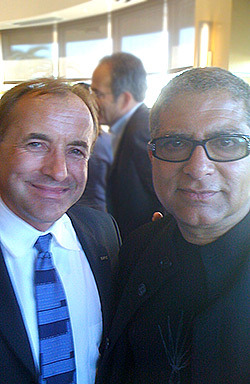
On Thursday, March 31, Deepak Chopra and I squared off for a second time in person in a public venue, this time accompanied by the physicist Leonard Mlodinow on my side and Stuart Hameroff on his side (along with other panelists). The question on the table was this:
“Is there an Ultimate Reality?” and if yes, “Can it be accounted for by science such as mathematics, biology and physics?”
My answers: YES and YES
I explained that I am a Materialist and a Monist. I do not believe that there is a body and a soul, there is just a body. There is no brain and mind, just brain. The mind is just a word we use to describe what the brain does. I said, “you know I’m right” (which got a surprising laugh from the audience) because of the evidence from strokes, tumors, brain damage, senility, dementia, and Alzheimer’s, all of which kill brain cells, and along with the loss of brain comes the loss of mind. I asked Deepak and Stuart where Aunt Millie’s mind goes when her brain slowly disappears from the effects of Alzheimer’s disease.
I noted that consciousness is just a word we use to describe our inner thoughts about the workings of the brain, and that our “soul” is just a pattern of information stored in our genes and our brains. Consciousness is just an emergent property of integrated brain modules and patterned firing of neural networks.
By contrast, I believe that Deepak’s use of the word “consciousness” is very anthropocentric, once again returning humans to a central place in the cosmos as the “observers” who, in quantum mechanics, brings things into existence. If Deepak is right then the moon doesn’t exist unless it is observed, and yet, quoting that great scientist Bill O’Reilly, “times come in, tides go out—never a missed communication—and they would do so whether or not humans, or any other conscious (or unconscious) being existed.
In fact, I said, Deepak’s quantum consciousness is not holistic but reductionistic in the extreme. We don’t need to go down that far. Quantum mechanics is not needed to explain brain functions: the neuron is the individual unit of thought, the “atom” of mind. I then worked in a little joke I wrote earlier in the day:
Quantum mechanics is spooky and weird.
Consciousness is spooky and weird.
So what? Charlie Sheen is spooky and weird, but we don’t need quantum mechanics to explain his behavior. His “tiger blood” theory works just fine.
Haha.
In Deepak’s worldview, everything is conscious, which means that there is no way to distinguish between consciousness and unconsciousness, which is how I often feel when I listen to Deepak.
Thought Experiment:
-
If humans went extinct instead of Neanderthals, how does that effect the universe?
-
What if the Earth were suddenly demolished by a rogue planet (as in 2012)? Would that mean the end of the universe because observers would disappear?
-
Are whales, dolphins, gorillas and chimps conscious and therefore integral to the universe?
-
What can it possibly mean to say that the universe is conscious? If you will pardon the nerd science pun, that is such a vacuous concept!
Before the debate Deepak asked me to read a paper by himself and Menas Kafatos and Rudolph Tanzi published in the Journal of Cosmology, entitled: “How Consciousness Becomes the Physical Universe.” Deepak asked me to comment on it, which I did in the second half of the debate. I noted that given the prominence of “consciousness” to the central theme of the paper that one might expect it to be defined with semantic precision. Nope. Here is what the authors write:
“We will sidestep any precise definition of consciousness, limiting ourselves for now to willful actions on the part of the observer.”
What can it possibly mean for the universe to be conscious in the sense of having willful actions? The universe behaves with willful action? The universe is an observer? As well, quantum mechanics only requires an observation of any kind: an electron microscope will do. Is an electron microscope willful? Does an electron microscope take action? The authors of this paper write:
Werner Heisenberg concluded that the atom “has no immediate and direct physical properties at all.” If the universe’s basic building block isn’t physical, then the same must hold true in some way for the whole. The universe was doing a vanishing act in Heisenberg’s day, and it certainly hasn’t become more solid since. And Heisenberg again: “The atoms or elementary particles themselves … form a world of potentialities or possibilities rather than one of things or facts.”
No, sorry, these are different levels of analysis. To prove it I challenge Deepak to climb to the top of this building and jump off and see if the ground is a potentiality or a thing! They also write:
Heisenberg: “What we observe is not nature itself, but nature exposed to our method of questioning.” Reality, it seems, shifts according to the observer’s conscious intent.
Once again, NO! This would imply that anyone’s method of questioning is just as valid as anyone else’s, which would mean that the way astrologers question the universe is just as valid as that of astronomers. I concluded by saying that if you want to get a spacecraft to Mars the questions that astronomers ask are absolutely objectively really better than those of astrologers. Q.E.D.!
In Deepak’s rebuttal, in discussing quantum mechanics, he actually used the phrase “the womb of creation.” Nice. It’s that sort of precise language that makes people all gushy and mushy about science. I pressed him for a definition of consciousness, which he gave me as “consciousness is the ground of existence.” I replied that this sounded tautological to me: since reality needs consciousness to come into existence, this means that reality = consciousness = existence; or existence = existence. A is A. Very Aristotelian. But what does that really tell us?
In the end I pressed both Deepak and Stuart Hameroff for an answer as to where Aunt Millie’s mind goes during the ravages of Alzheimer’s disease. Stuart’s answer was so rapid fire and jargon laden (something about the collapse of the wave function inside the microtubules in the neurons inside Aunt Millie’s brain) that I couldn’t quite get an answer, so Deepak clarified it for me later: Aunt Millie’s mind is in the matrix. Okay, I asked, how does poor Aunt Millie access the matrix. “We’re working on that,” was the reply. Okay, fine, and if our memories really are stored somewhere outside of our brains, then that would indeed be one of the greatest discoveries ever made in the history of science: Nobel worthy. But, until that is proven, I remain … skeptical.
Post Script
I am often asked if I believe that Deepak believes what he says, with an underlying assumption behind the question that Deepak is knowingly selling snake oil and doesn’t really believe his public patter. Having gotten to know Deepak over the years I can assure you that he absolutely positively believes what he says, and that while he may make a lot of money in the process of writing books, giving lectures, hosting radio and television shows, and running his various business enterprises (but, hey, that’s not exactly something anathema in America), this fact is quite orthogonal to his deeper mission in life: to shift the Western worldview Eastward.
I had never met Stuart Hameroff before, but I liked him as well, sharing a beer after the debate while watching a Laker game and schmoozing about science. Although I do not accept his theory of consciousness (most neuroscientists are skeptical as well), it would be fun to engage him again in a spirited debate over the brain and the mind.