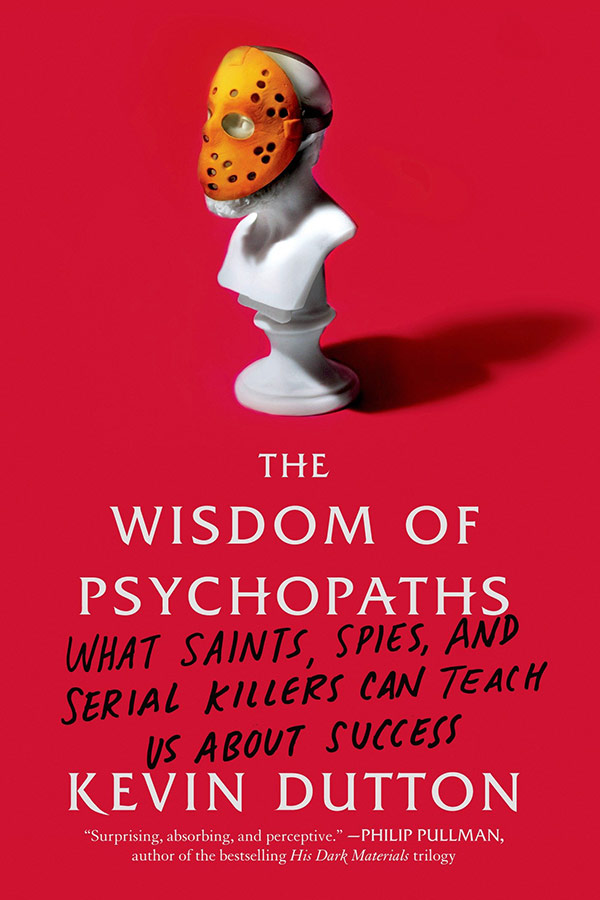
A review of The Wisdom of Psychopaths: What Saints, Spies, and Serial Killers Can Teach Us About Success by Kevin Dutton. A a version of this review was published in the Wall Street Journal on November 6, 2012 under the title “When Madness Pays Off”.
In one of her standup comedy routines Ellen Degeneres riffs on those commercials for depression medications that begin “Do you ever feel sad?”, to which Degeneres responds sardonically, “Yes, I’m alive!”
The problem with all diagnostic tools is that they attempt to squeeze into a well-defined box symptoms or characteristics that are often fuzzy, ill-defined, context dependent, and on some level a part of daily life, so the criteria lists grows and the diagnostic labels broaden into spectrums. Everyone occasionally feels sad, so some depression might indeed be considered part and parcel of living. Recent research suggests, for example, that mild depression may be one way of coping with a bad situation that, like pain, is a signal to make a change. But as it ratchets up in intensity to the point of causing dysfunction, then depression may indeed be a diagnosis in need of a treatment. Autism is another example, with the “autism spectrum” ranging from barely functional children requiring full-time care to the famous author Temple Grandin, who earned a Ph.D. in animal science and was ranked by Time magazine as one of the 100 most influential people in the world. A single word fails to capture the spread.
“Psychopathy” suffers the same problem. Psychopathy is a spectrum personality disorder characterized by callousness, antisocial behavior, superficial charm, narcissism, grandiosity, a sense of entitlement, a lack of empathy and remorse, and poor impulse control and criminality. A slate of publications on psychopathy over the past two decades—from Robert Hare’s path-breaking 1991 book Without Conscience to Simon Baron Cohen’s 2011 The Science of Evil—reveal that about 1–3 percent of men in the general population are psychopaths, and that about half of all violent criminals in prison have been diagnosed as psychopathic. Indeed, psychopathy is almost always associated with criminals and serial killers, but as the University of Cambridge research psychologist Kevin Dutton argues in The Wisdom of Psychopaths, within psychopathy there are shades of grey, from one end of the spectrum inhabited by CEOs, lawyers, salesmen, Wall Street Traders, and tough-minded bosses who enjoy growling “You’re fired!”, to the other end inhabited by the likes of Ted Bundy who, after raping and murdering 35 women in the 1970s, boasted “I’m the coldest son of a bitch you’ll ever meet.” (continue reading…)
Comments Off on Positive Psychopathy
Does new research prove paranormal precognition or normal postcognition?
PSI, OR THE PARANORMAL, denotes anomalous psychological effects that are currently unexplained by normal causes. Historically such phenomena eventually are either accounted for by normal means, or else they disappear under controlled conditions. But now renowned psychologist Daryl J. Bem claims experimental proof of precognition (conscious cognitive awareness) and premonition (affective apprehension) “of a future event that could not otherwise be anticipated through any known inferential process,” as he wrote recently in “Feeling the Future” in the Journal of Personality and Social Psychology.
Bem sat subjects in front of a computer screen that displayed two curtains, behind one of which would appear a photograph that was neutral, negative or erotic. Through 36 trials the subjects were to preselect which screen they thought the image would appear behind, after which the computer randomly chose the window to project the image onto. When the images were neutral, the subjects did no better than 50–50. But when the images were erotic, the subjects preselected the correct screen 53.1 percent of the time, which Bem reports as statistically significant. (continue reading…)
Comments Off on Extrasensory Pornception
How optimism trumped realism in the positive-psychology movement
I am, by nature, an optimist. I almost always think things will turn out well, and even when they break I am confident that I can fix them. My optimism, however, has not always served me well. Twice I have been hit by cars while cycling— full-on, through-the-windshield impacts that were entirely the result of my blissful attitude that the street corners I had successfully negotiated hundreds of times before would not suddenly materialize an automobile in my path. Such high-impact, unpredictable and rare events are what author Nassim Nicholas Taleb calls “black swans.” Given enough time, no upward sloping trend line is immune from dramatic collapse.
A bike crash as a black swan is, in fact, an apt metaphor for what the investigative journalist and natural-born skeptic Barbara Ehrenreich believes happened to America as a result of the positive-thinking movement. In her engaging and tightly reasoned book Bright-Sided (order on DVD Ehrenreich’s lecture at Caltech), she shows how the positive-psychology movement was born in the halcyon days of the 1990s when the economy was soaring, housing prices were skyrocketing, and positive-thinking gurus were cashing in on the motivation business. Academic psychologists, armed with a veneer of scientific jargon, wanted in on the action. (continue reading…)
read or write comments (12)
Psychological research reveals how
and why liberals and conservatives differ
Humans are, by nature, tribal and never more so than in politics. In the culture wars we all know the tribal stereotypes of what liberals think of conservatives: Conservatives are a bunch of Hummer-driving, meat-eating, gun-toting, hard-drinking, Bible-thumping, black-and-white- thinking, fist-pounding, shoe-stomping, morally hypocritical blowhards. And what conservatives think of liberals: Liberals are a bunch of hybrid-driving, tofu-eating, tree-hugging, whale-saving, sandal-wearing, bottled-water-drinking, ACLU-supporting, flip-flopping, wishy-washy, namby-pamby bed wetters.
Like many other stereotypes, each of these contains an element of truth that reflects an emphasis on different moral values. Jonathan Haidt, who is a psychologist at the University of Virginia, explains such stereotypes in terms of his Moral Foundations Theory (see www.moralfoundations.org), which he developed “to understand why morality varies so much across cultures yet still shows so many similarities and recurrent themes.” Haidt proposes that the foundations of our sense of right and wrong rest within “five innate and universally available psychological systems” that might be summarized as follows: (continue reading…)
read or write comments (21)
Evolutionary economics explains why irrational
financial choices were once rational
Since 99 percent our evolutionary history was spent as hunter-gatherers living in small bands of a few dozen to a few hundred people, we evolved a psychology not always well equipped to reason our way around the modern world. What may seem like irrational behavior today may have actually been rational a hundred thousand years ago. Without an evolutionary perspective, the assumptions of Homo economicus — that “Economic Man” is rational, self-maximizing, and efficient in making choices — make no sense. Take economic profit versus psychological fairness as an example. (continue reading…)
read or write comments (21)