Recently my friend and colleague in science and skepticism Neil deGrasse Tyson, issued a public statement via BigThink.com in which he stated that he dislikes labels because they carry with them all the baggage that the person thinks they already know about that particular label, and thus he prefers no label at all when it comes to the god question and simply calls himself an agnostic.
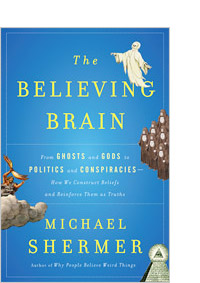
The Believing Brain
by Michael Shermer
In this book, I present my theory on how beliefs are born, formed, nourished, reinforced, challenged, changed, and extinguished. Sam Harris calls The Believing Brain “a wonderfully lucid, accessible, and wide-ranging account of the boundary between justified and unjustified belief.” Leonard Mlodinow calls it “a tour de force integrating neuroscience and the social sciences.”
(continue reading…)
Comments Off on Are you an Atheist or Agnostic?
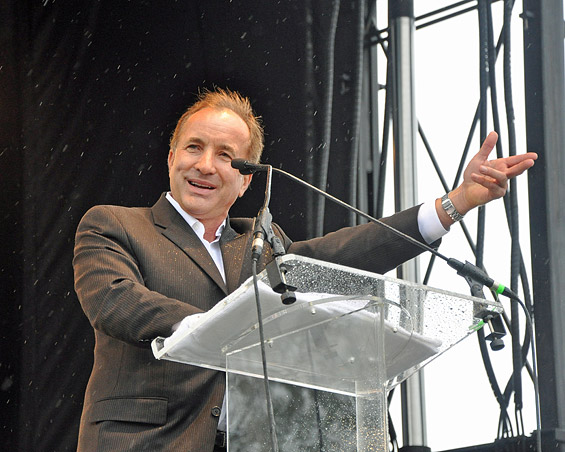
Yours truly, leading the Reason Rally Cheer (photo by John Welte)
March 24, 2012 marked the largest gathering of skeptics, atheists, humanists, nonbelievers, and “nones” (those who tick the “no religion” box on surveys) of all stripes on the Mall in Washington, D.C., across from the original Smithsonian museum. Crowd estimates vary from 15,000 to 25,000. However many it was, it was one rockin’ huge crowd that voiced its support for reason, science, and skepticism louder than any I have ever heard. Anywhere. Any time. Any place. It started raining just as the festivities gathered steam late morning, but the weather seemed to have no effect whatsoever on the enthusiasm and energy of the crowd…or the speakers and performers. The organizer and host David Silverman and his posse of tireless staff and volunteers pulled it off without a hitch. Organizing big events can be an organizational nightmare, but they did it, marking what I hope is the first of many consciousness raising events in the civil rights movement for equal treatment for us nonbelievers and skeptics. (continue reading…)
Comments Off on Reason Rally Rocks
Last month, the Indiana State Senate approved a bill that would allow public school science teachers to include religious explanations for the origin of life in their classes. If Senate Bill 89 is approved by the state’s House its co-sponsor, Speaker of the House Dennis Kruse, hopes that this will open the door for the teaching of “creation-science” as a challenge to the theory of evolution, which he characterized as a “Johnny-come-lately” theory compared to the millennia-old creation story in Genesis: “I believe in creation and I believe it deserves to be taught in our public schools.” In this bill Kruse is challenging the U.S. Supreme Court’s 1987 decision in Edwards v. Aguillard that the mandatory teaching of a bible-based creation story in Louisiana public schools was violative of the first amendment and therefore unconstitutional (by a vote of 7-2, with Rehnquist and Scalia dissenting). “This is a different Supreme Court,” Kruse defiantly said in an interview. “This Supreme Court could rule differently.”
The language of the bill, however, was expanded by the Indiana State Senate Minority Leader Vi Simpson, a democrat, and includes the possibility of teaching the creation stories of religions other than Christianity. “The bill was originally talking about ‘Creationist Science,’ and I thought that was a bit of an oxymoron,” Simpson told the Village Voice. “I wanted to draft an amendment that would do two things. First, it would remove it from the science realm. And second, school boards and the state of Indiana should not be in the business of promoting one religion over another.” The bill now includes the following proviso: “The governing body of a school corporation may offer instruction on various theories of the origin of life. The curriculum for the course must include theories from multiple religions, which may include, but is not limited to, Christianity, Judaism, Islam, Hinduism, Buddhism, and Scientology.” (continue reading…)
Comments Off on Teaching Allah and Xenu in Indiana
A couple weeks ago, I participated in an online debate at Evolution News & Views with Center for Science & Culture fellow Michael Flannery on the question: “If he were alive today, would evolutionary theory’s co-discoverer, Alfred Russel Wallace, be an intelligent design advocate?” Before reading this week’s post, you can review my opening statement in my previous Skepticblog and Flannery’s reply. The following is my response. A link to Flannery’s final reply can be found near the end of this page.
Michael Flannery’s assessment of Alfred Russel Wallace as a prescient scientist who anticipated modern Intelligent Design theory is premised on the belief that modern evolutionary biologists have failed to explain the myriad abilities of the human mind that Wallace outlined in his day as unanswered and—in his hyperselectionist formulation of evolutionary theory—unanswerable. In point of fact there are several testable hypotheses formulated by scientists—evolutionary psychologists in particular—that make the case that all aspects of the human mind are explicable by evolutionary theory. Flannery mentions just one—Steven Pinker’s hypothesis that cognitive niches in the evolutionary environment of our Paleolithic hominid ancestors gave rise to abstract reasoning and metaphorical thinking that enabled future humans to navigate complex social and cognitive environments found in the modern world. In his PNAS paper Pinker outlines two processes at work: “One is that intelligence is an adaptation to a knowledge-using, socially interdependent lifestyle, the ‘cognitive niche’.” And: “The second hypothesis is that humans possess an ability of metaphorical abstraction, which allows them to coopt faculties that originally evolved for physical problem-solving and social coordination, apply them to abstract subject matter, and combine them productively.” Together, Pinker concludes: “These abilities can help explain the emergence of abstract cognition without supernatural or exotic evolutionary forces and are in principle testable by analyses of statistical signs of selection in the human genome.” Pinker then outlines a number of ways in which the cognitive niche hypothesis has been and can continue to be tested.
In point of fact, Darwin himself addressed this larger problem of “pre-adaptation”: Since evolution is not prescient or goal directed—natural selection operates in the here-and-now and cannot anticipate what future organisms are going to need to survive in an ever-changing environment—how did certain modern useful features come to be in an ancestral environment different from our own? In Darwin’s time this was called the “problem of incipient stages.” Fully-formed wings are obviously an excellent adaptation for flight that provide all sorts of advantages for animals who have them; but of what use is half a wing? For Darwinian gradualism to work, each successive stage of wing development would need to be functional, but stumpy little partial wings are not aerodynamically capable of flight. Darwin answered his critics thusly: (continue reading…)
Comments Off on The Natural & the Supernatural: Alfred Russel Wallace and the Nature of Science
A couple weeks ago, I participated in an online debate at Evolution News & Views with Center for Science & Culture fellow Michael Flannery on the question: “If he were alive today, would evolutionary theory’s co-discoverer, Alfred Russel Wallace, be an intelligent design advocate?” The following is my opening statement in the debate. A link to Flannery’s reply can be found near the end of this page.
The double dangerous game of Whiggish What-if? history is on the table in this debate that inexorably invokes hindsight bias, along the lines of “Was Thomas Jefferson a racist because he had slaves?” Adjudicating historical belief and behavior with modern judicial scales is a fool’s errand that carries but one virtue—enlightenment of the past for correcting current misunderstandings. Thus I shall endeavor to enlighten modern thinkers on the perils of misjudging Alfred Russel Wallace as an Intelligent Design creationist, and at the same time reveal the fundamental flaw in both his evolutionary theory and that of this latest incarnation of creationism.
Wallace’s scientific heresy was first delivered in the April, 1869 issue of The Quarterly Review, in which he outlined what he saw as the failure of natural selection to explain the enlarged human brain (compared to apes), as well as the organs of speech, the hand, and the external form of the body:
In the brain of the lowest savages and, as far as we know, of the prehistoric races, we have an organ…little inferior in size and complexity to that of the highest types…. But the mental requirements of the lowest savages, such as the Australians or the Andaman Islanders, are very little above those of many animals. How then was an organ developed far beyond the needs of its possessor? Natural Selection could only have endowed the savage with a brain a little superior to that of an ape, whereas he actually possesses one but very little inferior to that of the average members of our learned societies.
(Please note the language that, were we to judge the man solely by his descriptors for indigenous peoples, would lead us to label Wallace a racist even though he was in his own time what we would today call a progressive liberal.) (continue reading…)
Comments Off on Alfred Russel Wallace was a Hyper-Evolutionist, not an Intelligent Design Creationist