Michael Shermer appeared on the Singularity 1 on 1 podcast after meeting its creator, Nikola (a.k.a “Socrates”), at a recent Singularity Summit in New York (watch Michael’s lecture). Discussion included a variety of topics such as: Michael’s education at a Christian college and original interest in religion and theology; his eventual transition to atheism, skepticism, science and the scientific method; SETI, the singularity and religion; scientific progress and the dots on the curve as precursors of big breakthroughs; life-extension, cloning and mind uploading; being a skeptic and an optimist at the same time; the “social singularity”; global warming; the tricky balance between being a skeptic while still being able to learn and make progress.
During the last week of 2011, I spoke at and attended a wonderful salon in Santa Fe, New Mexico organized and hosted by Sandy Blakeslee, the brilliant science writer for the New York Times and the author of numerous engaging popular books on neuroscience. Two of the speakers at the salon addressed the topic of the decline of crime, one (Byron Johnson) attributing it to god and the other (John Lott) to guns. Of the two, Lott by far took the day with superior data and better arguments, although for a much wider and deeper analysis of the decline of violence in general I highly recommend Steven Pinker’s The Better Angels of Our Nature: Why Violence Has Declined (Viking, 2011), which I recently reviewed in these pages.
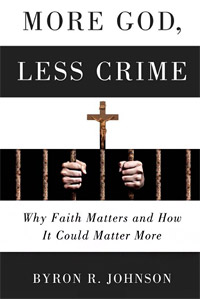
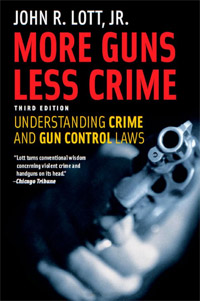
Byron Johnson is a professor at Baylor University and the founding director of the Baylor Institute for Studies of Religion as well as director of the Program on Prosocial Behavior. Acknowledging that he took the title of his book, More God, Less Crime: Why Faith Matters and How It Could Matter More (Templeton Press, 2011) directly from Lott’s book, More Guns, Less Crime: Understanding Crime and Gun Control Laws (University of Chicago Press, 2010), Johnson mostly recounted his experiences working with prisoners in an attempt to lower recidivism rates by increasing religiosity…of the Christian variety, of course. What few data slides he presented harmed his case more than helped it by being either impossible to read (dark, small type) or countering his claim (one slide showed no difference in post-conversion crime rates). Even his anecdotes seemed to gainsay his thesis, as in recounting the story of one man who even after converting to Christianity refused to confess his crime of rape and murder of a young girl until he met her mother on the day of his execution, at which point he broke down and apologized to her. Additional anecdotes and frank admissions by Johnson only worsened his case, such as that many prisoners only convert in order to impress parole boards, and that many of his fellow Christians (he called them “high octane” evangelicals) were only in the game to tally up conversion scores in an environment ripe for the picking. (I routinely receive letters from prisoners who bemoan the constant evangelizing, not only by Christians but by Muslims as well who also see prisons as conversion opportunities. As the Russian comedian Yavak Smirnoff used to joke about performing in the USSR, mixing “captured” for “captive” audiences: “they’re not going anywhere!”) (continue reading…)
Comments Off on More God, Less Crime or More Guns, Less Crime?
Foreigners could be forgiven for thinking that America is fast becoming a theocracy. No fewer than three of the remaining Republican candidates (Rick Perry, Rick Santorum, and Michele Bachmann) have declared that they were called by God to run for the country’s highest office. Congress recently voted to renew the country’s motto of “In God We Trust” on nothing less than the coin of the realm. And this year’s Thanksgiving Forum in Iowa (co-sponsored by the National Organization for Marriage) featured most of the major Presidential candidates competing for the title of God’s quarterback.
Rick Santorum, for example, in the course of denouncing Islamic Sharia law, inadvertently endorsed the same as long as it is a Christian on the Judge’s bench: “Unlike Islam, where the higher law and the civil law are the same, in our case, we have civil laws. But our civil laws have to comport with the higher law.” Not content to speak in such circular generalities, Santorum targeted his faith: “As long as abortion is legal—at least according to the Supreme Court—legal in this country, we will never have rest, because that law does not comport with God’s law.” God’s law? That is precisely the argument made by Islamic imams. But Santorum was only getting started. “Gay marriage is wrong. The idea that the only things that the states are prevented from doing are only things specifically established in the Constitution is wrong. … As a president, I will get involved, because the states do not have the right to undermine the basic, fundamental values that hold this country together.” Christian values only, of course. (continue reading…)
Comments Off on E Pluribus Unum for all faiths and for none
On November 4, the Los Angeles Times published my Opinion Editorial entitled “What’s God Got to do With it?” (which I also posted on Skepticblog) about Congress reaffirming our national motto “In God We Trust.” I argued that trust does not come from God but from very specific social, political, and economic institutions.
Chuck Colson, the one-time special counsel for President Richard Nixon, one of the Watergate Seven who also pleaded guilty to obstruction of justice in his attempt to defame the Pentagon Papers defendant Daniel Ellsberg, and the man who found God and Jesus just in time for his jail sentence in federal prison, now blogs on political and social issues from a Christian perspective and has attempted a smack-down of my Op-Ed by arguing that “God Has a Lot to Do With It.”
His argument is summarized in his own words thusly:
It was Christianity, you see, that taught the West that all human beings are created in the image of God. Without that understanding, the very words of the Declaration of Independence, “that all Men are created equal, that they endowed by their Creator with certain inalienable Rights,” could never have been written.
Most of all, our ideas about what constitutes a free and secure society are derived from Christianity. Political scientist Glenn Tinder has written about how much of what we celebrate in our society, like the “respect for the individual and a belief in the essential equality of all human beings,” has “strong roots in the union of the spiritual and the political achieved in the vision of Christianity.”
He may be invoked in the national motto, but God has nothing to do with why Americans are free and secure
This op-ed was originally published in the Los Angeles Times, Friday November 4, 2011.
The House of Representatives voted last week by a margin of 396–9 to reaffirm as the national motto the phrase “In God We Trust,” and encouraged its pronouncement on public buildings and continued printing on the coin of the realm. The motto was made official in 1956 during the height of Cold War hysteria over godless communism and—in the words of Brig. Gen. Jack D. Ripper in Stanley Kubrick’s and Peter Sellers’ 1964 classic antiwar film Dr. Strangelove—“Communist infiltration, Communist indoctrination, Communist subversion and the international Communist conspiracy to sap and impurify all of our precious bodily fluids.”
As risible a reason as this was for knocking out a few bricks in the wall separating state and church, it was at least understandable in the context of the times. But today, with no communist threats and belief in God or a universal spirit among Americans still holding strong at about 90%, according to a 2011 Gallup Poll, what is the point of having this motto? The answer is in the wording of the resolution voted on: “Whereas if religion and morality are taken out of the marketplace of ideas, the very freedom on which the United States was founded cannot be secured.” (continue reading…)