Michael Shermer appeared on the Singularity 1 on 1 podcast after meeting its creator, Nikola (a.k.a “Socrates”), at a recent Singularity Summit in New York (watch Michael’s lecture). Discussion included a variety of topics such as: Michael’s education at a Christian college and original interest in religion and theology; his eventual transition to atheism, skepticism, science and the scientific method; SETI, the singularity and religion; scientific progress and the dots on the curve as precursors of big breakthroughs; life-extension, cloning and mind uploading; being a skeptic and an optimist at the same time; the “social singularity”; global warming; the tricky balance between being a skeptic while still being able to learn and make progress.
How to compute the odds that claims of extraterrestrial life discovery are real and reliable
The Search for Extra-Terrestrial Intelligence (SETI) has to be the most interesting field of science that lacks a subject to study. Yet. Keep searching. In the meantime, is there some metric we can apply to calculating the probability and impact of claims of such a discovery? There is.
In January, 2011 the Philosophical Transactions of the Royal Society published 17 articles addressing the matter of “The Detection of Extra-Terrestial Life and the Consequences for Science and Society,” including one by Iván Almár from the Hungarian Academy of Sciences and Margaret S. Race from the SETI Institute, introducing a metric “to provide a scalar assessment of the scientific importance, validity and potential risks associated with putative evidence of ET life discovered on Earth, on nearby bodies in the Solar System or in our Galaxy.” Such scaling is common in science—the Celsius scale for temperature, the Beaufort scale for wind speed, the Saffir-Simpson scale for hurricane strength, and the Richter scale for earthquake magnitude. But these scales, Almár and Race argue, fail to take into account “the relative position of the observer or recipient of information.” The effects of a 7.1 earthquake, for example, depends on the proximity of its epicenter to human habitations.
An improvement may be found in the Torino Scale that computes the likelihood of an asteroid impact and the risk of its potential damage—from 1, a near miss with no danger, to 10, certain impact with catastrophic consequences. But Almár and Race note that “the scale does not include any consideration of the observations’ reliability.” Building on SETI’s Rio Scale for evaluating the effect on society of an ET discovery, Almár and Race propose the London Scale that multiplies Q x δ, where Q (scientific importance) is the sum of four parameters:
life form (1–5, from Earth-similar life to completely alien),
nature of evidence (1-6, from indirect biomarkers to obviously organized complex life),
type of method of discovery (1–5, from remote sensing to return mission sample), and
distance (1–4, from beyond the Solar System to on Earth).
This sum is then multiplied by δ (a reliability factor) ranging from 0.1–0.5, from probably not real to highly reliable. The maximum Q can be is 20 x .5 = 10.
For example, Almár and Race compute the odds that the Allan Hills 84001 Martian meteorite contains alien life as (2+2+4+4)0.3 = 3.6 for scientific importance and credibility, noting that “several scientific counter-arguments have been published and the discovery has not been generally accepted.” I would assess the recent claim of arsenic-based life in Mono Lake as (2+1+4+4)0.2 = 2.2, fairly low by comparison.
Such scientific scales attempt to bring some rigor and reliability to estimates of events that are highly improbable or uncertain. The process also reveals why most scientists do not take seriously UFO claims. Although the first two categories would yield a 5 and a 6 (completely alien and complex life) and its distance is zero (4, on Earth), the method of discovery is highly subjective (perceptual, psychological) and open to alternative explanation (1, other aerial phenomena) and the reliability factor δ is either obviously fake or fraudulent (0) or probably not real (0.1), and so Q = (5+6+1+4)0.1 = 1.6 (or 0 if δ = 0).
The Phoenix lights UFO claim, for example, was a real aerial phenomena witnessed by thousands on the evening of March 13, 1997. UFOlogists (and even Arizona governor Fife Symington) claim it was extraterrestrial, but what is δ for this event? It turns out that there were two independent aerial events that night, the first a group of planes flying in a “V” formation at 8:30 that started a UFO hysteria and brought people outdoors with video cameras, which then recorded a string of lights at 10:00 that slowly sank until they disappeared behind a nearby mountain range. These turned out to be flares dropped by the Air National Guard on a training mission. Ever since, people have conflated the two events and thereby transmogrified two IFOs into one UFO. So δ = 0 and Q shifts from 1.6 to 0, which is how much confidence I have in UFOlogists until they produce actual physical evidence, the sine qua non of science.
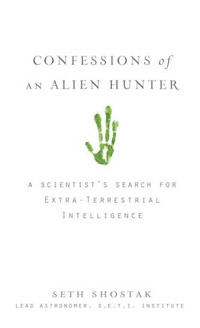
I’m a big fan of SETI (Search for Extra-Terrestrial Intellience) and I think their search program constitutes the best chance we have of making contact. In fact, on a recent Saturday I was rained out of my normal 4-hour bike ride, so I read SETI scientist Seth Shostak’s new book, Confessions of An Alien Hunter (published by National Geographic), a brilliant and fun read. Seth has a fantastic sense of humor and in his book he presents some of great one-liners to use when dealing with UFOlogists, alien abductees, and the saucerites. For example:
Regarding the time it would take to traverse the vast distances between the stars, which would be millions of years (it will take Voyager II 300,000 years to reach a nearby star), Shostak notes: “That’s a long time to be squirming in a coach seat.”
As for the lack of tangible evidence for UFOs: “Physical evidence — a taillight or knob from an alien craft — is in short supply.”
UFOlogists claim that they have tens of thousands of UFO sightings, as if this is a good thing, but Shostak notes that this actually argues against UFOs being ET, because to date not one of these tens of thousands of sightings has materialized into concrete evidence that UFOs = ETIs. It’s counterintuitive, but more sightings equals less certainty because with so many saucers zipping around we would have captured one by now, and we haven’t.
Shostak notes that crop circles are a very poor means of communication because they represent only a few hundred bits of information, 1,679 bits in the most complex crop circle to date, which is less than a paragraph of text! If ETIs are advanced enough for interstellar space travel, why resort to using wheat fields, which are only ripe a couple of months a year, and then the crop-circle communication is quickly mowed down by angry farmers!
As for alien abductees, Shostak points out that Whitley Strieber’s book, Communion, launched the modern alien abduction movement. And guess what Strieber does for a living? He is a SciFi/fantasy/horror writer! Actually, I knew this already because I met Strieber in the green room at Bill Maher’s ABC show, Politically Incorrect, and Whitley and I were chatting it up over coffee and granola bars in the green room before the show when I asked him what he did when he wasn’t writing about being abducted by aliens. He told me that he writes science fiction, fantasy, and horror novels. The show was over right there in the green room! What else is there to say to a guy who writes this stuff as fiction, then slaps a “nonfiction” label on the book jacket?
Comments Off on How to Talk to a UFOlogist (if you must)
The lifetime of civilizations in the Drake equation for estimating extraterrestrial ntelligences is greatly exaggerated
In science there is arguably no more suppositional formula than that proposed in 1961 by radio astronomer Frank Drake for estimating the number of technological civilizations that reside in our galaxy: N = R fp ne fl fi fc L
In this equation, N is the number of communicative civilizations, R is the rate of formation of suitable stars, fp is the fraction of those stars with planets, ne is the number of Earth-like planets per solar system, fl is the fraction of planets with life, fi is the fraction of planets with intelligent life, fc is the fraction of planets with communicating technology, and L is the lifetime of communicating civilizations. (continue reading…)